Friday, September 2, 2022

SHARPNESS REVISITED


August '22 visit to the Severn Estuary


50 years ago Tony and his brother owned a Trawl Fishing company out of Plymouth, fishing in the Channel between Portland and Land’s End. Those were the days when the raping and scraping of the seabed wasn’t regarded as a sacrilege. Attitudes have changed since then. However, going back to about 1978, their biggest boat needed her prop shaft examined and the nearest dry-dock which would accommodate her was at Sharpness up the Severn estuary. Tony spent several weeks up there, overseeing the job and became interested in the area. The docks are at the entrance of the Gloucester Canal from the Severn.

We have revisited the area and followed the canal, several times since, and now in Post-Covid(??) times we felt we’d like to have a few days in the van’s first outing since the pandemic began, and renew our acquaintance with this area, so different from Cornwall.


August 23rd 2022

We left home late, at ten am. We must be getting old! There were a few drops of rain and the sky was looking very unsettled as we left, but it gradually brightened as we got beyond Exeter. Our first interest was a Red Kite flying over the M5 as we approached Cullompton.


We reached Bridgewater about midday and crossing a small swing bridge over a canal reached through an industrial estate on the outskirts of town, we parked near a waterside pub.


Swing Bridge over the Taunton to Bridgewater Canal. This connects the River Tone to the Parrett  at Bridgewater


                                  Canal-side Pub.

The canal, constructed in 1827, connected the River Tone at Taunton to the River Parrett and thence the sea.

It is 14.5 miles long and has seven locks.


Patches of floating Frogbit and luxuriant vegetation in the bank-sides almost hid the boats moored at intervals along the towpath


Home from Home?


In the afternoon we drove on up the A38 and driving through Cannington we took the lanes out towards Steart Point at the mouth of the Parrett estuary.

We stopped in 'our usual corner' where there is now another ubiquitous notice forbidding overnight parking and camping.


A very workmanlike rig was already parked. We walked out to the long cobble bank protecting the salt marsh from the sea. It was low tide and a wide expanse of mud was ahead. A few Black-headed Gulls were loafing on the mud offshore but otherwise there was little birdlife to be seen.


The nuclear power station at Hinkley Point looms to the south, but the huge construction of Hinkley B. could hardly be seen in the rather hazy conditions.

After a quick walk out to the cobble bank we headed back down the road a little way to  where we could park and walked along a bank to a 'blind' ; a wooden 'wall' from which bird-watchers could watch any birds on the saltmarsh. This is now part of a very extensive wetland reserve created in 2014. 


The new wetland reserve, created by allowing sea water to flood extensive areas of wet-lying grazing meadows and alleviating flooding of properties.


Showing flooded area. This is now a wildlife area of great significance, although at this time of the year as the autumn passage of birds has barely started, the marshes as we saw them at low water and during this very dry spell, were very quiet.

We then drove  towards Glastonbury along the A39 and along the top of the Polden Hills and down to Catcott Reserve on the Somerset Levels. The  Levels were looking refreshingly green as the water management here is to keep the water table high by closing the sluices in the rhynes (drainage ditches) so they were full of water, covered by bright green Duckweed.


Looking from the hide by the small carpark at Catcott,  we were pleased to see between 40 and 50 Cattle Egrets among the cattle. They now breed in this area and are another addition to the increasing number of heron species now settling and spreading their range in Britain.

Later in the evening the cattle had wandered off into the marshy ground to graze, the egrets had dispersed and we saw a Great White Egret striding the adjacent rushy lagoon, long-legged , its long neck leaning forward, pointing its strong yellow beak ahead as it hunted.

As the evening light faded, black duck-shapes were making duck movements, leaving scarcely a ripple on the glassy water. The silence was profound and the stillness complete.

Wednesday 24th Aug.

Yesterday evening's threatening black clouds didn't come to anything and we awoke to a fresher breeze and early sun which soon clouded over.

A pre-breakfast visit to the hide produced five Gadwall among the numerous Mallards. They were picked out by the white speculum in their wings, and black stern. The Great White Egret had resumed its patrol of the rushy lagoon to our left, watched by a family of Mute Swans with their well-grown brood of seven in grey-brown plumage. Bands of light drizzle swept across the marshes at times.

Sharpness was our main destination this trip and we resumed our northward journey in heavy traffic till we reached the Sharpness car park beside the big lock which gives access to shipping coming up the Severn to the docks.

The dangerous moving mud banks and erratic currents in the huge tidal range of the Severn make it compulsory to take a pilot on board any vessel over a given size, to navigate the estuary from Bristol to Sharpness and on up to Gloucester.


The tricky entrance to the big lock giving access from the estuary to the docks and on up the canal to Gloucester.


Common Gull perching on the lock wall.


The docks, dating from 1825 are said to be the eighth biggest in the UK apparently. We were sorry to see there is no longer a notice at the lock office about notification of shipping due in and out of the docks. They used to give the date, the tide time, the cargo and originating or destination port of ships due in the current week. It is always good to gongoozle the manoeuvres.
The port is important for the collection and export of scrap metals of all kinds and there is a busy traffic of heavy lorries carrying scrap to the extensive warehouses lining the waterway between the main lock and the start of the canal.


Sarah B, a bulk-cargo coaster, being unloaded. The cargo looked like fertilizer.

The port is a muddle of big warehouses both in use and derelict, areas of scrub, securely fenced places, tag-ends of old rail tracks with marooned and rusting old rolling stock, and busy active dock activities. The whole area has the canal running though, crossed by several swing bridges, until it abruptly gives way to the moorings for leisure and long-boat basin and the canal proper, going on its wide placid way between trees to Gloucester to the north east. In Sharpness itself there are few dwellings; the main housing, shops and facilities are just beyond, in Newtown.


The Dockworkers' Union Clubhouse area where camping is tolerated. We have stayed there on several occasions; now, with the internet connections, the word has spread and we arrived to find several others already there and were later joined by a couple more vans.
A path leads from here back to the docks or down to the canal basin and towpath.


At the bottom of the footpath down from the Dockworkers' club. Looking down the estuary from the canal basin. The two Severn Bridges are blotted out in the haze, but they span the gap in the far horizon.


Just behind the previous camera shot, we saw fresh Otter footprints in mud as it trekked across to look for shore crabs in the seaweed on the shore.

Note the Otter prints have 5 claws. The smaller paler prints on the right have only 4 front pads and are of a dog or a fox.


Looking up the estuary  at about half-tide. The water is hiding the stumps of the pillars supporting the spans of the original railway bridge.  This railway crossed the canal on the right by a swing bridge and then several spans crossed the estuary to Lydney on the Gloucestershire shore on the left.  In 1960 two big barges loaded with fuel lost control in thick fog and collided  under the bridge. There was a huge explosion and the bridge was destroyed. Five lives were lost. The damaged bridge was eventually totally demolished in 1967.


The older, original lock from the estuary, leading to the upper canal basin. It is now silted up and out of use .Below is a picture of the original canal basin, pre-dating the present docks.


The head of the canal basin with moored leisure and longboats.


The memorial to the Merchant Navy training ship.

When I was a child the boy next door trained on her in the early 1940s, before becoming a cadet officer. He was torpedoed twice in the war as a teenager but survived.


The towpath going towards Gloucester. The Severn is close on the left at this place and makes a good vantage point from which to see and hear Reed Warblers in the reedbed below the wall.

The Purton Hulks.

A couple of miles up the towpath is another swing bridge over the canal at a hamlet called Purton..In 1909 there was a catastrophic collapse of the canal bank which threatened to drain this all-imp0rtant canal. In this place, the canal and river were less than 50 yards apart. An emergency plan was swiftly put in place and several old wooden barges, locally built and once locally used but now derelict, were floated to the collapse and beached to shore the bank up .Ships from all over the country were subsequently added to the defences. Over time, several concrete barges were also beached here to prevent further erosion by strengthening the bank.

A group of dedicated volunteers known as 'The Friends of Purton' have researched the history of all the beached barges and have erected explanatory plaques. The site has become known as 'the ships' graveyard' and is a modest tourist attraction.


All that now can be seen of the barge 'Envoy'


.The remains of several of the concrete barges reinforcing the river bank.

Short though this trip was, we always find the combination of the history and the current on-going life of this working port, very interesting, and with the added attraction of a very pleasant towpath walk.


Saturday, August 13, 2022

SUMMER VISIT TO NW. WALES


In spite of the eye-watering cost of diesel now, we decided to go up to Kim’s in the van now we have got it through the MoT. Hoping to repeat the successful arrangement of last summer, we plan to go up for a week, overlapping with Angus and Brendan’s week there for a few days in the middle of our visit. It’s less pressure on Kim if we aren’t all there for the whole time, especially if the weather’s poor.

August 1st ‘22

Although the diary said today is a bank holiday, there were a lot of heavy lorries on the roads, as well as cars and what seemed to be tradesmen going about their work. [It turned out it was only a public holiday in Scotland and Ireland] We left about 7am and stopped at 9 for breakfast at the Taunton Deane services. The Somerset countryside was looking golden with ripe corn and stubbles and the gleaning rooks, starlings and gulls.

By midday we reached the Gilfach Valley, a nature reserve a bit north of Rhayader. There were several cars in the car-park near the entrance so we drove on up the valley till we could turn and stop beside the road, and ate our lunch looking back down the valley over extensive coniferous/ birch woodland and the willow wood along the stream. The steep hillsides were grazed moorland with rocky outcrops.

Looking down the Gilfach valley


While Tony slept after lunch, I walked up the road enjoying the fine views and the big clumps of ling growing among the boulders on the hillside.


 Huge slabs of slate have been up-ended and used as a fine boundary.


We continued northwards and this time took the road from Llanidloes directly cross country past Llyn Clywedog and then along narrow single track but fortunately quiet, lanes then up and over the great mountain pass beyond Malltwyd to rejoin our more usual road at Cross-Foxes. This avoids the busy and bendy road up to Machynllech and then to Dolgellau.

We had originally planned to meet Kim a bit south of Trawsfynedd to stop overnight in Snowdonia and put out the moth trap. Our mid-journey phone conversation told us that rain was forecast to set in about 4pm so not fancying a wet night for either Kim in her bivvy-bag or for the moth trap, we decided to scrap that plan and go straight on to Ty'n Gamdda. We arrived at Kim’s at Ty’n Gamdda at 4-30pm as it started to rain! So it was a wise choice! There was half an inch of rain over the next 18 hours.


Tuesday 2nd Aug.

The drizzle continues and with a brisk SW wind. Jane came over and we settled down to a good catch-up chat. Largely an ‘in day’ with almost half an inch of rain.


Wed.3rd August.

Sunny and warm. We watched the comings and goings of Willouby’s Leafcutter bees bringing big pieces of leaf to various holes Gwydion had drilled in some big blocks of wood. We watched from the sunny clearing in the back garden. This year the bees are also using the drainage holes near the base of a plant pot there.


Blocks of wood with holes bored for solitary bees.


Willouby's Leaf-cutter Bee with piece of rose leaf before dragging it into a hole at the base of a pot plant.


Rose leaf with almost circular sections cut out by leafcutter bees. They take mere seconds to remove each piece of leaf.


Later we drove to Widlin on the North coast of Pen Lleyn, and Kim and I walked across a couple of fields from the lane to the cliff top. From there we could look down into the small bay, across rocks to the far end where a thick layer of sandy head material overlies the rock. There are about 17 Sand Martins’ nest holes there and we could see the comings and goings of several martins at a distance. Nearer along the beach we could see a Whimbrel and three Common Sandpipers feeding on the scattered seaweed near the high tideline and a couple of Oystercatchers and a few Black-headed Gulls.

The yellowish patch at the top of the cliff at the far end of the bay is where the sand Matins have excavated their nest holes.

Two or three Sandwich Terns were flying and occasionally plunging into the sea, calling with their rusty screeches and then returning to the beach where a youngster was persistently begging for food from the returning adults, usually without success.


A Grayling butterfly came and settled just in front of us. They always close their wings as soon as they alight, and lean over sideways a little so only their camouflaged under - wing is seen.


Towards the end of the afternoon we went to pick blackberries along the track beyond Cau Crin. There is a fine crop of good big, well-flavoured ones along here. Stewed and strained, they make a delicious puree with Greek yoghurt.

Patches of Harebells always adorn the banks around here.

At twilight we set up the Skinner moth trap in the top corner of the hayfield, hoping it would be more or less sheltered from the fresh westerly wind.

Skinner moth trap in the hay field.

Half of the hayfield was cut this afternoon. K & G have left it late so the insects could enjoy the flowers. They are only cutting half so that next year they can compare growth and insects in the two differently managed areas.


Thursday 4th August

Kim got up at 5.30 and switched off the moth trap and covered it before going on her morning walk along the cliff and we opened up after breakfast. Despite the breeze and clear sky we had a respectable catch of 64 individuals of 40 species. A few were new for the year for Kim and me too, as I don’t get coastal species in inland SE Cornwall. Scarce Footman is a novelty for me and so too is the Yellowtail and Crescent Dart, but all of which we trap in Brittany.

During our visit we walked down from time to time, to the pond Kim dug in the bottom corner of the hay field last year. It is beginning to settle in quite well, with clumps of marginal and emerging plants including Water Plantain, Bogbean and various rushes and sedges looking established. Small quantities of duckweed have appeared and the water lily has a succession of beautiful white flowers opening every day. So far there is about 90% open water surface so plenty of space for pond skaters, water boatmen and whirligig beetles, and Kim has seen six different species of Dragonflies and damsels, some mating and laying eggs. The myriad toad tadpoles have long since grown and taken to dry land. Sitting on the bench at one end, we watched birds coming to drink and bathe ; House Sparrows, Linnets, Goldfinches and a Pied Wagtail all pottered on the surrounding shores of cobbles and a gang of three or four swallows repeatedly flew round and swooped down low over the water, either drinking or catching insects. The resident Swallows nesting in the woodshed near the house have so far fledged their first brood of five and are busy feeding their second brood.


The pond after about a year.

Angus and Brendan his second son, eleven years old, (one of our grandsons) arrived for a week’s stay, this evening. Brennie’s first job was to say hello to the hens and sheep. The black twin lambs, born in the spring, were new to him.

Brennie cutting young leafy willow for the sheep.


Friday 5th August

The morning was social, with visits from Kim’s friend Jan and from Viv & John who have recently moved to Aberdaron from the Forest of Dean. Very keen and knowledgeable naturalists, they are a very welcome addition to the area.

Gwydion turned the hay this afternoon after the heavy dew had dried off.

In the evening we carted the Skinner moth trap and all the accompanying paraphernalia in the wheelbarrow, up to Bywchestyn and Angus and Brennie set up their tent on the cliff-slope beyond. Kim lit the light in the trap as it was getting dark about 9.30 and took her swag to sleep alongside Angus and Brendan. Brendan began the night sleeping out in his sleeping bag but by the morning he had retreated, covered in dew, into the tent.


Saturday 6th August

Angie got up at 5.30 and switched off the moth light and covered the trap which they later brought down to the house to open. We had a more moderate catch this time, with about 53 individuals of 17 species, many of which were Flounced Rustics, but also handsome Antlers and True Lover’s Knots, both to be found in moorland situations. A new species for Kim was a Nutmeg. Brennie tubed most of the moths from the egg boxes which they were roosting in at the bottom of the trap. Young fingers and reactions are very dexterous. After identifying and counting, the catch was released back on the cliff.


Nutmeg, a new moth for this site .


Then picnic and sea-going equipment (for snorkelling, canoeing and paddleboarding) were assembled and we drove the few miles to a small bay on the north coast of the peninsula, Porth Ysgaden, where we could readily indulge the water babies of the party. Kim warned us it could be busy as it was a Saturday in the height of the holiday season and the nearby farms all have camp-sites these post-pandemic days. Little did any of us realize just HOW busy it would be. Cars choked the top of the bay and were parked alongside the road for hundreds of yards back. Vehicles towing trailers with boats were trying to get to the bay, and those already unloaded were trying to get parked.

As it was lunchtime already, we just took our picnic and snorkels and wet suits and walked along the clifftop path a short way and sat on the grass looking down into a narrow inlet just to the south of Porth Ysgaden.

Snorkelling inlet just round the corner from Porth Ysgaden.

Next, when the snorkelling had lost interest, came the job of blowing up the paddleboard and canoe-----both inflatables these days. Kim helped them down to the slipway and came back with tales of queues to launch and utter bedlam with people trying to launch various craft and others trying to land. This is the nearest slipway for all the area’s campers so it is very popular but a real bottleneck. It would have been a horrible shock and no doubt we’d have turned away if we’d been unprepared for a crowd.

Kim, Angus & Brendan with snorkels.


Angus in canoe and Brennie on paddleboard, Porth Ysgaden.


Sunday 7th August

Today's first job was to construct a new compost compound in the narrow strip of veg. garden going down to the pond beside the hayfield. When filled and the compost rotted down, kim will use this as a raised bed to keep the constant problem of rabbits off the crop.

Angus & Kim making the new compost compound.

Tony had brought up the net and tray which he uses in Cornwall to look at river invertebrates to assess water quality in the River Seaton. He and Kim were interested to see how the stream which joins the river at Aberdaron compared. This stream has run dry near the usual confluence so we went up the valley a bit till the water was still running among the big boulders in its bed.


They sampled among the boulders a bit upstream from the bridge at Cyll y Felin (Hazel Mill)

The standard sampling method was used to give a measurable comparison and although the water level was low and rather cloudy, they were pleased to find they had caught five small sticklebacks and a good number of Stonefly larvae as well as caddis larvae and other species which we were unfamiliar with. So all-in-all, the fish, Gammarus (Freshwater Shrimps) and other species indicated a reasonable water quality despite rather unpromising appearances. Back at Ty'n Gamdda we set up Angus’s small aquarium with water pump for a short stay for the sticklebacks to watch them for a while before returning them to Cyll y Felin.


Back at Tyn Gamdda, looking at the river sample.


Some of the unidentified invertebrates from the sample.


The hay was turned for the second time this afternoon.

Monday 8th Aug.’22

An early start to load up our gear, clean the barn and off down the road by nine am.

We’d opted for the Cross-Foxes/ Malltwyd route again and made good time on a lovely morning.

We stopped for our lunchtime picnic by the River Wye beyond Builth Wells ,on a back road in a small quiet lay-by a mile or so upstream from the pretty little suspension bridge between Erwood and Boughrood. It was sunny and hot with scarcely any air moving, and we were glad to park in dappled shade beside a luxuriant growth of Meadowsweet, Ground Elder and nettles partly under the sweeping low-slung branches of a big Wych Elm. Speckled Wood and a Silver-washed Fritillary butterfly were flitting around.

As we sat, we became conscious that every now and then a little puff of whitish dust was erupting from a couple of taller-than-the-rest, nettles. These plants, like the rest of the nettles in that patch, were in flower and we realized that they were males whose inflorescences were mature and in the warm dry air were splitting open their pollen sacs and the white pollen was being released. The light breeze was wafting the little clouds away, to become invisible within a foot from the plant, but the minute pollen grains would still be in the air. Some could alight on a female nettle flower and then fertilize it to produce seed.

 The scientific name of the Stinging nettle is Urtica dioecia. Urtica refers to the stinging hairs on the plant which give a painful rash; the dioecia specific name tells us that the male and female flowers are produced on separate plants, thus ensuring cross-pollination and a vigorous mixing of genes.

We have never witnessed this pollen eruption from nettles, and it also reminded us how many microscopic particles travel through the air without us ever being aware. As the sun moved a bit, more nettle plants were lit up and warmed, and they too started to explode little puffs of pollen.


Stinging nettle in flower.

This was the highlight of a journey which became hotter, slower and more tedious as we got embroiled in heavy traffic from Bristol south to Weston-super- Mare, and we were glad to get home. We phoned Ty’n Gamdda to let them know we’d arrived safely and they told us the hay had been bailed and the 38 bails were safely stacked in the shed.

Monday, July 4, 2022

Rowden Meadow


A green lane or old track leads between the fields from the NW of Stokeclimsland, to finish these days at a lane. In the past it continued towards the extensive woodlands of the Tamar Valley upstream from Gunnislake. These woodlands are mainly coniferous now but were in the past heathy ridges above a steep valley-side clothed with ancient oak woods. The track must have originally continued through what is now a strip of rough meadow becoming increasingly narrow, until it come to another lane, but it is supposed by local historians, to have been an old droveway to the heathy land at the crest of the deep valley.


Rowden Strip Meadow in March '21. Looking down from entrance gate.

Until a few years ago this narrow strip of meadow was used by a local woman to graze horses but it has subsequently fallen out of use and the Parish Council has taken it over for the community. This has led to a variety of suggestions from interested parties, from dog-walkers to horse riders, an open classroom for children or students, but it has been recognised as a valuable wildlife site because of its comparative lack of management. The hedges running the length of the strip on the north and south sides have a great variety of shrubby and tree species. The part to the west is dominated by tussocky Cocksfoot grass and the further end has an increasing stand of bracken. Among and below this coarse growth is a variety of other herbaceous plants supporting a rich diversity of moths, as already indicated by a few moth trapping events during the last two seasons. Other invertebrates are also no doubt abundant


.Last autumn for example, the area of cocksfoot tussocks was adorned with magnificent Orb Spiders' webs draped across the clumps of tall grass, spangled with dew which shone like jewels in the low morning sun.


Moth Trap.


Many moths have been trapped, identified and then released in several moth-trapping nights over the past 18 months, including this Privet Hawk Moth, the largest native British  moth..

Its caterpillar eats Ash leaves as well as privet.


Bank voles are frequently seen under mats about 18" square laid down to shelter such creatures

.


Walks through the strip at different seasons have shown a variety of beetles, butterflies, day-flying moths, deer, and foxes.


Occasionally, a Roe Deer may be startled, and will swiftly leap into the next field.


Bloody-nosed Beetle, so named because when it's alarmed it exudes a red unpleasant-tasting liquid from its joints which deters birds from eating it.

It is a flightless beetle, generally  seen in spring. It's larvae eat mainly Hedge Bedstraw.


Five-spot Burnet. This is a day-flying moth emerging in June. It's caterpillars feed on Birdsfoot Trefoil.
It has five spots on each wing. In this picture the fifth spot is mostly covered by the overlapping wings. It closely resembles the related Six-spot Burnet.


In early spring the central part of the meadow is a carpet of the golden stars of Lesser Celandine.


Later in the spring, the hedge bottoms and banks are dominated by the red, white and blue of patches of Greater Stitchwort (seen above), Bluebells and Red Campion.


The species-rich hedges of the Rowden Meadow are punctuated by the white blossom of Blackthorn and later, with Bullace, and then Hawthorn, Guelder Rose and Wild Apple (pictured above)


Bright yellow Brimstone butterflies can be seen flying up and down the meadow in search of the paler yellow female. Their caterpillars feed on Alder Buckthorn, another species of shrub to be found in the Rowden hedges.


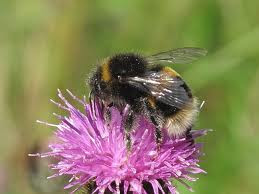
The warmth of summer days encourages insects such as this Buff-tailed Bumble -bee.


Later still, the brambles are flowering and attract hoverflies such as this big Bumble-bee mimic.This Volucella bombylans is a nectar-feeder and neither bites nor stings.


Autumn brings its own bounty of hedgerow fruit, such as this Spindle, with dark red Haws, purple Sloes, acorns and these bright shiny Guelder Rose berries.(below)


It has been recognised that the wildlife in this strip of meadow needs to be identified and recorded for two or three years during different seasons, to get an idea of what is there, before any management or intervention is done.

The present variety of habitat, with richly-diverse woody species in the hedges on each side of this strip, and the unimproved grassland within it, will arguably hold a greater diversity of wildlife than if it is in the future, completely un-managed and closed natural woodland develops .Already, without grazing, seedling Oaks and Willow, and suckering Thorn are appearing within the grassy area; Bramble and Bracken are encroaching; all signs of the natural succession of plants in their inexorable efforts to revert to woodland when there is no human intervention. 
At some time within a few years, a management plan needs to be instigated and executed, because the size f this meadow strip is too small to be 're-wilded'. 
The current hot topic of 're-wilding' as exempilfied on the Knepp Estate and some  areas in Scotland, is more appropriate when practiced in large areas of land, with sufficient space for a mosaic of vegetation  of different ages to develop. These habitats are  created by the free grazing of a limited number of various animals, each favouring different feeding strategies, from ground-disturbing foraging by pigs to grass-eating and browsing herbivores.